
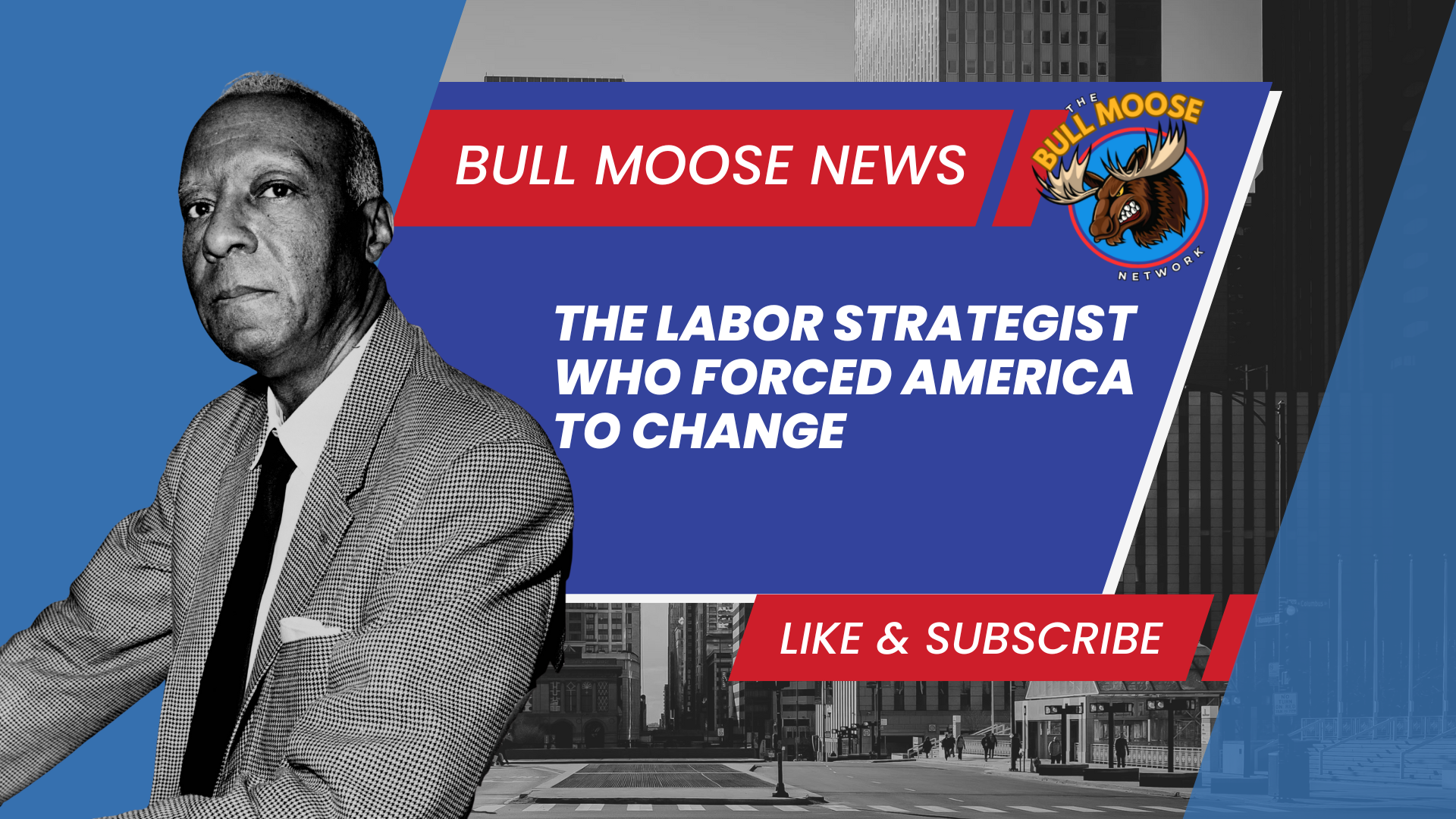
If American history were honest, A. Philip Randolph would be taught alongside names like Martin Luther King, Jr. He was one of the central engineers of power in the 20th century. Not a dreamer. Not a symbol. A strategist. A laborer. A guy who understood, early and correctly, that racism survives best when it’s welded to a paycheck.
Randolph didn’t start with speeches. He started with workers who already knew they were being screwed.
Pullman porters were everywhere and nowhere at once. Black men in crisp uniforms carrying bags, shining shoes, absorbing insults, paid starvation wages to smile while America slept. They were expected to be invisible professionals: dignified enough to serve, disposable enough to ignore. The Pullman Company liked it that way. So did most of the country.
Randolph looked at that system and said: Organize it.
In 1925, when founding a Black-led union was still treated like an act of sedition, he built the Brotherhood of Sleeping Car Porters. It took twelve years of firings, intimidation, blacklists, and company spies before Pullman was forced to recognize it. Twelve years. That alone tells you something about the man. He didn’t confuse justice with speed. He understood pressure. He understood endurance. He understood that power only listens when it has no other choice.
Randolph didn’t beg white institutions for inclusion. He forced them to negotiate. When the Brotherhood was finally admitted to the American Federation of Labor, it wasn’t charity; it was leverage. The first Black labor union recognized by the AFL arrived because Randolph made exclusion more expensive than acceptance.
That was his real gift. He made injustice costly.
When World War II loomed, and defense jobs exploded, while Black workers were still locked out, Randolph didn’t write op-eds or wait his turn. He threatened a March on Washington. Not a symbolic one. A mass disruption aimed straight at the federal government’s credibility during wartime. Franklin Roosevelt didn’t wake up one morning enlightened. He folded under pressure and signed an executive order banning discrimination in defense industries.
That move didn’t come from the kindness of power. It came from Randolph standing calmly in front of it and saying, we will embarrass you at scale.
He did it again with the military. Same tactic. Same result. Truman desegregated the armed forces not because history demanded it, but because Randolph was prepared to make the alternative politically untenable.
This is the part that often gets sanitized: Randolph wasn’t asking for representation. He was asserting agency. He wasn’t appealing to American ideals. He was exploiting American weaknesses.
By the 1950s and ’60s, younger civil rights leaders were learning nonviolent protest not as a moral performance, but as a disciplined weapon. Randolph understood that nonviolence wasn’t passive. It was confrontational without being suicidal. It forced the system to reveal itself—on camera, in public, in front of witnesses.
So when the 1963 March on Washington happened, it wasn’t spontaneous. It was engineered. Jobs were in the title for a reason. Labor was never a side issue for Randolph—it was the spine. Civil rights without economic power, he knew, would always be conditional.
He lived long enough to see the movement win victories and then stall. Long enough to watch capitalism rebrand inequality as freedom. Long enough to know the fight wasn’t finished.
When Randolph stepped away from public life in 1968, he left behind more than organizations. He left a blueprint: organize workers first, apply pressure relentlessly, never confuse symbolism with power, and never accept “not yet” as an answer.
Black History Month has no shortage of martyrs. What makes A. Philip Randolph dangerous, even now, is that he lived, planned, and won. He proved that workers could bend the state. That racism could be confronted structurally. That the most radical thing a Black man could do in America was demand collective bargaining.



Leave a Reply